Global supply chains are vulnerable, leading to long lead times for critical industrial components.
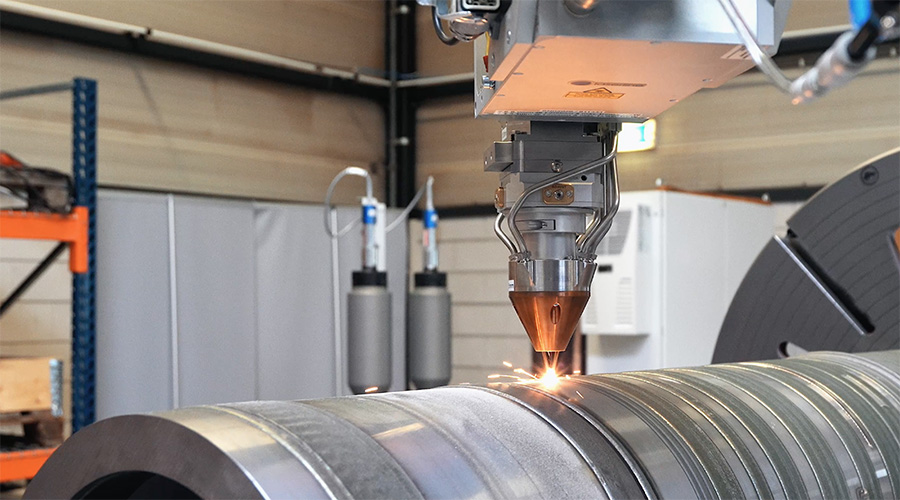
With the laser cladding systems from Hornet Laser Cladding, companies can restore wear-sensitive parts locally to a improved condition. This approach eliminates long lead times, significantly reduces the Total Cost of Ownership (TCO), and creates a more independent supply chain.
The Current Crisis: Waiting is Not an Option
For capital-intensive industries, such as maritime, oil & gas, mining, and heavy machine manufacturing, the cost of unplanned downtime severely impacts operational margins. When a critical component, like a drive shaft or hydraulic cylinder, fails, the traditional reflex for decades was simple: replace it.
Today, however, this 'replace' strategy carries operational risks:
- Long lead times: New large or custom OEM parts frequently have lead times of 6 to 12 months.
- Fluctuating costs: The prices of raw metals and international shipping are unpredictable.
- Strategic dependency: Your supply chain becomes dependent on foreign suppliers and vulnerable to global disruptions.
The solution for decision-makers and investors demanding operational continuity lies in insourcing high-quality repair.
The 4 Strategic Advantages of In-House Laser Cladding
-
On-Site Repair Capabilities
Investing in a Hornet Laser Cladding system allows you to manage critical repairs internally. For components that simply cannot or should not be moved, solutions like The Hornet Mobile bring the full power of robotic laser cladding directly to your production facility or shipyard. This eliminates the heavy transport logistics and drastically reduces downtime. -
Configurable Specifications
The process deposits alloys precisely where needed. Systems are configurable for conventional cladding or EHLA (Extreme High-Speed Laser Cladding) to meet the technical requirements of hydraulic rods, turbine blades, or ground-engaging tools. -
Standardized Operation
Advanced surface technology traditionally requires specialized robotic programming. Hornet systems utilize a proprietary HMI and the Hornet Robot APP, featuring pre-programmed macros. Operators input basic dimensions for standard geometries (like cylinders or flanges) directly via the touchscreen, removing the need for a dedicated software engineer. -
Material Efficiency
Repairing an old part requires only a small amount of new material. This cuts down on waste and helps the environment by keeping the existing metal in use.
Standardized Industrial Systems
Hornet Laser Cladding manufactures EU-compliant systems designed for continuous operation. The equipment configurations match specific production requirements:
- Turnkey Systems: Custom configurations up to 26 meters in length, utilizing up to 10 interpolated axes for large-scale industrial parts.
- The Hive: A modular, laser-safe enclosure designed for medium-to-high volume production and multi-site standardization.
- The Hornet Mobile: A fully transportable robotic system designed to perform high-quality on-site repairs for large, immovable components. Incorporating this technology shifts maintenance from an external procurement process to a controlled internal operation.
Learn more about the technical specifications of our systems and contact us.


