Selecting the right surface coating technology is an essential decision for protecting industrial parts from wear, corrosion, and harsh environments.
Two frequently used methods are laser cladding and thermal spraying. Both technologies can substantially improve component performance and lenghtening service life, but they vary in how coatings are applied and the properties they provide.
What makes these technologies different, and which is the right choice for your application? Understanding their advantages and limitations can help you make the right decision.
What is the difference between laser cladding and thermal spraying?
Although both technologies are used to enhance the surface properties of metal components, the main difference lies in how the coating bonds to the base material.
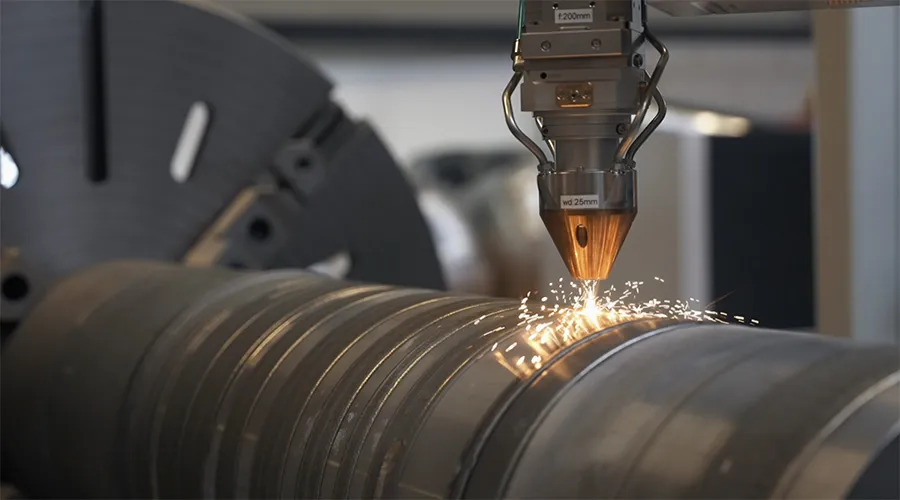
Laser cladding: Uses a focused laser beam to melt metallic coating material and a thin layer of the substrate. As the material solidifies, it forms a strong metallurgical bond. The result is a long-lasting coating that holds up well against wear and corrosion.
Thermal spraying: This involves heating coating materials and spraying them onto a prepared surface at high velocity. The particles solidify upon impact, creating a coating that is primarily mechanically bonded to the substrate.
Both processes offer valuable advantages, but the difference in bonding mechanisms can have a big impact on coating performance and long term reliability.
Why choose laser cladding?
Laser cladding has become an increasingly popular alternative to conventional surface coating technologies. Its ability to create dense, metallurgically bonded coatings makes it particularly suitable for demanding industrial applications. Here are four key reasons to choose laser cladding:
- Strong metallurgical bonding: Laser cladding creates a strong metallurgical bond with the substrate, reducing the risk of delamination and improving component reliability and service life under demanding operating conditions.
- Wear and corrosion resistance: Laser cladding applies dense, low-porosity coatings using high-performance alloys to improve wear and corrosion resistance, providing trustworthy protection for essential industrial components.
- Minimal heat input and distortion: Laser cladding uses controlled, thermal input to minimise distortion and preserve the mechanical properties of the base material. This makes it ideal for components with exact tolerances or complex geometries.
- Repair and part restoration: Laser cladding repairs worn or damaged parts by fusing new material layer-by-layer via a focused laser beam, extending their service life while lowering replacement costs, material consumption and environmental impact.

When is thermal spraying the better choice?
Thermal spraying is suitable for thermosensitive parts, large surfaces and applications requiring specialised coatings. Methods such as HVOF and Plasma Spraying can apply metals, ceramics and carbide-based materials with minimal heat transfer to the substrate.
However, unlike laser cladding, thermal spray coatings mainly rely on mechanical bonding and may require additional sealing or surface treatment, depending on the application.
Laser cladding vs. thermal spray: Key differences
The most suitable technology depends on the parts, operating environment and required coating properties.
|
Property |
Laser Cladding |
Thermal Spraying |
|
Bonding method |
Metallurgical bond |
Primarily mechanical bond |
|
Coating density |
Dense, very low porosity |
Varies by process and material |
|
Heat input |
Localised and controlled |
Generally very low |
|
Corrosion protection |
Excellent with dense, suitable coatings |
Depends on coating density and material |
|
Material options |
Primarily metallic alloys |
Metals, ceramics and composites |
|
Component repair |
Excellent for dimensional restoration |
Suitable for selected repair applications |
|
Typical applications |
Shafts, hydraulic rods, valves and critical components |
Wear coatings, thermal barriers and large surfaces |
Both technologies can deliver excellent results when correctly matched to the application.
The key is understanding which coating properties are most important for the component’s operating conditions.
Discover Hornet Laser Cladding solutions
At Hornet Laser Cladding, we develop advanced laser cladding systems designed to match the demanding industrial production requirements.
Our solutions range from fully customised turnkey systems to the compact Hive™ platform and the Hornet Mobile™ system for on-site laser cladding applications.
With support for conventional laser cladding, EHLA, wide beam cladding and internal cladding, our systems provide the flexibility to match different production needs.
If you need a flexible, laser cladding solution tailored to your production requirements, explore our range of systems to find the best fit for your application?
Whatever your application, there's a system to match it. Explore our laser cladding systems or contact our team to discuss how we can help improve your production process.


